 Skip to content

Uncategorized
Canopy Tent Factory Guide

Nov
A canopy tent factory turns three inputs into a branded structure: printed polyester, welded steel tube and skilled sewing. Each input carries its own failure mode, and none of them appears on a price list. This canopy tent factory guide follows the product from fabric roll to packed carton. As a result, a buyer can see where quality is decided and where cost is added.
Most buyers meet a canopy tent factory through a quotation. That document compresses six disciplines into one number, and the compression hides everything that matters at the second event. Consequently, the sections below answer the questions a distributor, a promotional supplier or an event business asks during a first factory audit. Indeed, every figure here comes either from a published test method or from the arithmetic shown in each table.

What Does a Canopy Tent Factory Actually Produce?
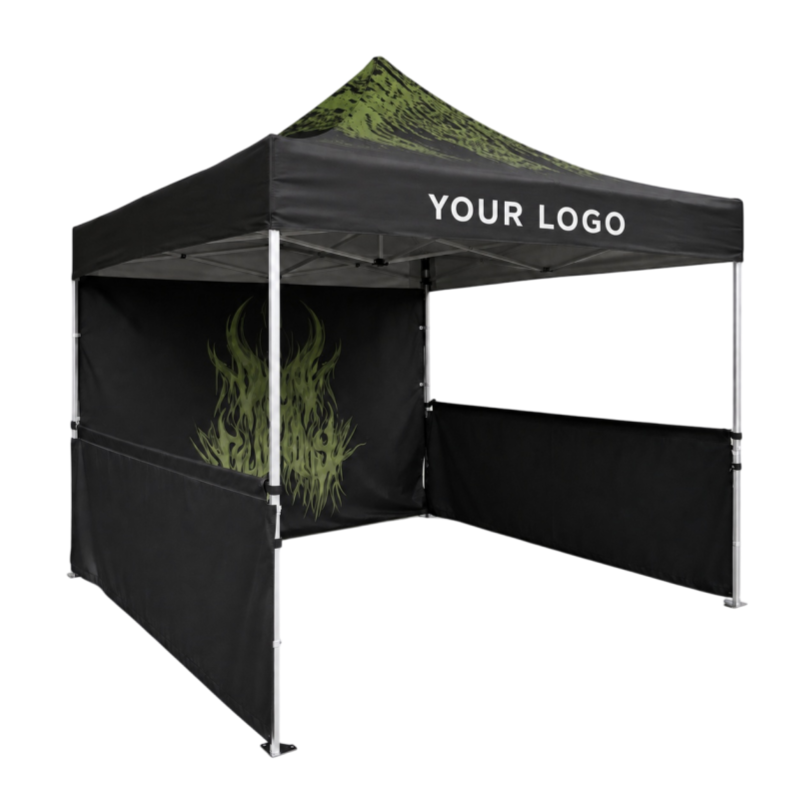
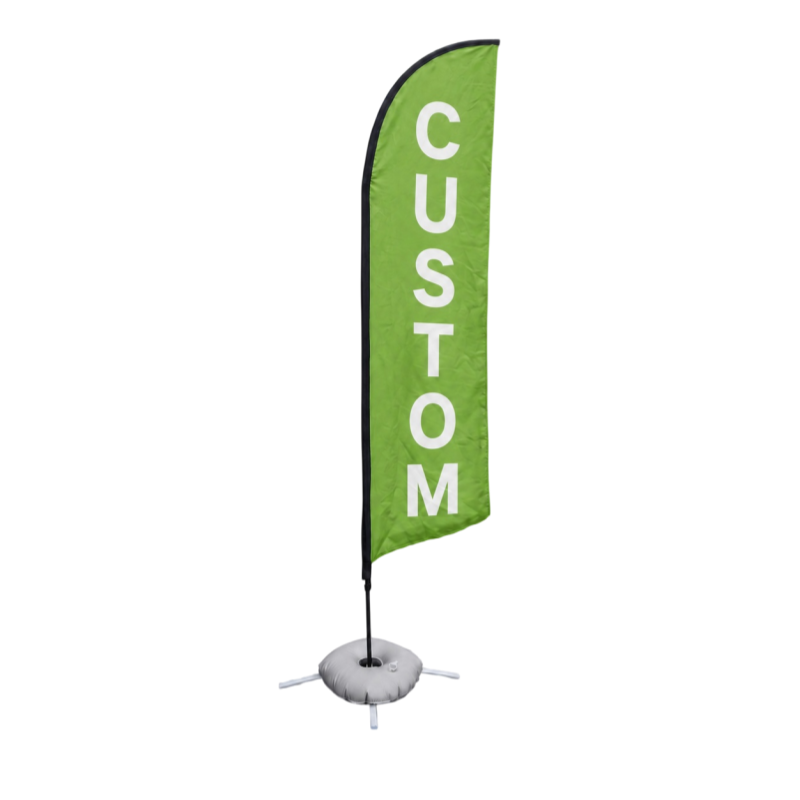
A modern canopy tent factory produces more than a roof and four legs. The category now covers pop-up frames, printed canopies, sidewalls, feather flags, folding furniture and the carry bags that hold them. Yutang, a manufacturer based in Tongling, Anhui, runs this full set on one site. Tents, flags, frames, chairs and rainwear share a single quality system there.
The product mix matters because a canopy tent factory that prints flags also prints canopies. Both use dye sublimation on polyester, both need colour management, and both fail at a seam before they
fail at the print. Therefore a buyer sourcing several display items from one supplier removes a layer of colour risk. The tent and the flag beside it will match under the same light.
Which Products Share One Production Floor?
Cutting, printing, sewing and frame assembly share a floor in a vertically integrated plant. Sharing is not cosmetic. A printed canopy and a flag cut from the same roll keep the same dye lot. Moreover, one sewing line applies the same stitch density to both. As a result, a matched set ordered together reads as one brand rather than two purchases.
Which Items Does the Factory Buy In?
No canopy tent factory makes every component on site. Zippers, webbing, grommets, spring buttons, nylon joints and packaging arrive from specialist suppliers. The honest question is not whether parts are bought in, but whether the factory tests them on arrival. A joint that cracks at minus ten degrees passes a visual check. As a result, incoming inspection needs a cold chamber as well as eyes.
How Did Yutang Reach 70,000 Square Metres?
Scale in this industry is measured in floor area, countries served and patents held, because those three numbers describe capacity, reach and design capability. Yutang has manufactured outdoor gear since 2005 and now operates a 70,000 square metre plant serving more than 120 countries and regions. The company also holds more than 80 self-owned patents across tent, chair and rainwear structures.
Those figures matter to a buyer for a practical reason. Floor area sets the number of parallel sewing lines, and parallel lines shorten the queue when one order runs long. A plant with a single line has no answer to a delay except a later ship date. A plant with several lines can move a rush order sideways. That flexibility is what a fixed event date actually buys.
Which Milestones Matter to a Buyer?
Two decades of production in one canopy tent factory leave a trail that a buyer can audit. Tooling for a 30 by 30 mm corner bracket, a library of print profiles and a set of export documents all accumulate with time. Furthermore, a long-running plant has already met the packaging rules of most destination markets, which removes a recurring source of delay at the port.
How Do Patents Help a Buyer?
A patent on a folding mechanism protects the buyer as much as the canopy tent factory. When a design is registered, a competing supplier cannot copy the joint and release a lookalike into the same retail channel. Equally, a buyer holding exclusive rights to a patented frame gains a structural difference that a competitor cannot match on price alone.
Which Steps Run Under One Roof?
Vertical integration sounds like a slogan until a buyer maps the route. Fabric arrives as a roll, gets cut, printed, sewn and inspected. Tube arrives as coil or length, gets cut, punched, welded and coated. The two streams meet at assembly, and the finished goods move to packing. In practice, six of those steps decide the final quality, and each one is visible on a factory tour.
Why Does Vertical Integration Change Lead Time?
Every handoff between separate factories adds transport and a queue. A canopy printed in one plant and sewn in another spends days in a van, and nobody owns the defect that appears in transit. Conversely, a single site inspects once and ships once, so the lead time loses the inter-plant leg entirely.
Where Does Outsourcing Still Happen?
In practice, specialist finishing stays outside in most plants, and that is a reasonable choice. Metal plating, embroidery on caps and printed packaging often run better at a dedicated supplier. The control point is documentation, because a factory that cannot name its plating supplier cannot trace a rust claim back to a bath chemistry problem.
How Does Dye Sublimation Print Onto Tent Fabric?
Dye sublimation is a phase-change process rather than an ink layer. A printer prints the artwork in reverse onto transfer paper using disperse dyes, then presses that paper against polyester at about 175 °C. At that temperature the dye turns to gas, penetrates the fibre and returns to a solid inside the polymer. In short, the colour becomes part of the yarn instead of sitting on top of it.
The consequence is durability. A sublimated print cannot crack, flake or peel, because no film remains on the surface to fail. It also cannot be felt as a raised layer, which matters on a canopy that folds along the same crease hundreds of times. Notably, the process works only on polyester and similar synthetic fibres, so the substrate choice is not free.
Why Does Polyester Take Dye and Cotton Not?
Polyester is thermoplastic, and its chains open slightly between 195 and 215 °C. That opening lets dye molecules diffuse into the polymer, and closing on cooling traps them inside. Cotton lacks that behaviour, so it takes dye through water-based chemistry instead. Therefore a canopy tent factory that promises sublimation on cotton is promising something the physics does not allow.
How Is Colour Fixed and Tested?
Colour fixation depends on time, temperature and pressure, and each one is recorded per batch. Nevertheless, a press that runs ten degrees cool produces a print that looks correct and crocks in the wash. Testing follows a rubbing and a washing standard. A factory should show results for the actual fabric and ink, not a generic certificate.
Which Fabric Weight Suits Which Tent?
In short, fabric choice sets the life of a canopy more than any other single specification. A canopy works through a coated woven cloth, and three numbers describe it. The first is yarn size in denier, the second finished weight in GSM. The third is hydrostatic head in millimetres. Those numbers move together, so a heavier cloth usually carries more coating and more water resistance.
A 600D canopy on a 25 mm frame is a mismatch in both directions. The cloth adds mass that the frame cannot carry, and the frame flexes at the roof truss until the seam opens. Matching cloth to tube is therefore the first rule of a canopy tent factory quotation. It is also the rule most often skipped when two prices sit side by side.
What Do Denier and GSM Each Measure?
Denier measures yarn linear density, meaning the mass in grams of 9,000 metres of filament. GSM measures the finished fabric, coating included. Consequently, two 600D cloths can differ by 40 gsm because one carries a heavier PU layer. Quoting denier alone describes the yarn and says nothing about the waterproof performance a buyer actually needs.
How Is Water Resistance Measured?
Hydrostatic head testing clamps a fabric sample under a rising column of water and records the height at which droplets appear. A 1,000 mm result holds against light rain, and a 3,000 mm result holds against sustained weather. Yet the test runs on a flat sample. A seam or a stitch hole can leak at a tenth of that pressure, so seam sealing belongs here too.
How Is a Tent Frame Welded and Coated?
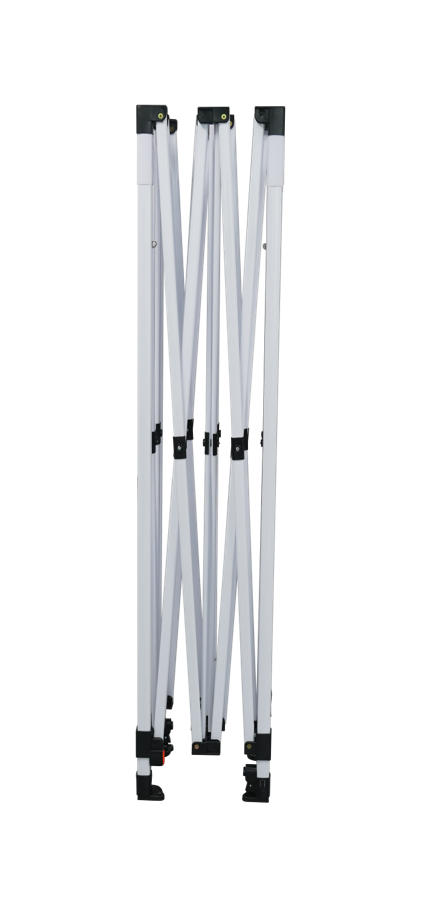
The frame carries the canopy and absorbs every gust, so its specification deserves the same scrutiny as the print. Four steel grades dominate the category, and the difference between them is yield strength rather than appearance. A 3 by 3 m frame in Q235 holds a normal event load. A 3 by 6 m span needs Q345 or a thicker wall to resist sagging at mid-span.
Tube arrives as welded strip drawn to size, and the seam position decides where a leg fails first. A seam on the outer face sits exactly where bending stress peaks, so a controlled mill places it away from the load. Subsequently, the tube is cut, punched at the button stations and welded into the truss.
Why Does Wall Thickness Beat Outside Diameter?
Stiffness rises with the cube of tube depth and only linearly with wall thickness, which sounds like a case for bigger tube. The practical limit is local denting at the button hole, and that failure depends on wall alone. A 30 by 30 mm tube with a 0.9 mm wall dents at the spring button within a season. As a result, 1.0 mm is the commercial floor, and 1.2 mm suits anything rented out.
Which Coating Survives Salt Air?
Coating choice separates a frame that lasts three years from one that lasts eight. Electro-galvanized tube carries 10 to 20 g/m² of zinc and survives 48 to 96 hours of salt spray. By contrast, hot-dip galvanizing reaches 500 to 1,000 hours. A duplex system adds powder coating over zinc and clears 1,000 hours, which is why coastal hire stock uses it.
What Does OEM Mean Compared With ODM?
OEM and ODM describe who owns the design rather than who owns the machine. In OEM, the buyer supplies the drawing and the canopy tent factory manufactures to it. In ODM, the factory holds the design and the buyer applies a brand. Both routes run through the same sewing lines, yet they carry different risks and different minimum quantities.
An OEM order starts with the buyer’s specification and tolerances, and the job of the factory is conformance. An ODM order starts with a market question, and the factory answers it from its own catalogue or patent portfolio. Therefore an ODM buyer evaluates taste and market fit, while an OEM buyer evaluates process control. Yutang runs both routes, alongside a private brand ODM service and a packaging line.
What Changes Under Private Label ODM?
In other words, private label ODM adds exclusivity to the ODM route. The buyer selects a design, the factory adapts colour, trim and packaging, and the finished item carries only the buyer’s mark. Exclusivity needs a written term, because a factory selling the same frame to three brands in one market turns three brands into one.
How Does Packaging Fit a Brand?
Packaging is the last manufacturing step and the first thing a customer touches. A carry bag, a carton and a polybag each carry their own compliance rules. A canopy tent factory that prints its own bags controls that part of the timeline. Besides, retail carton sizes drive container loading, so a box that misses a pallet pattern costs freight on every unit.
How Does a Custom Order Move Through the Factory?
A custom order follows six stages, and the sequence is fixed because each stage produces the input for the next. Consultation fixes the specification, and design turns it into artwork and a bill of materials. Sampling proves both, production repeats the sample, and quality control releases the batch. Finally, delivery closes the loop. Yutang quotes three to four weeks for production and shipping on a typical order.
When Does the Sample Stage Pay for Itself?
A sample costs money and a week, and it removes the largest single risk in the order. Artwork on a screen hides scale errors. A 10 mm logo on a 3 by 3 m roof reads as a speck from ten metres. Furthermore, a sample reveals the hand of the fabric and the stiffness of the frame. It also shows the shade of the print in daylight, which a PDF cannot.
Which Delays Come From the Buyer?
In fact, most late shipments trace back to an input that arrived late. Artwork in a raster format, a Pantone reference without a coating match, or a logo approval that waits four days all push the calendar. A factory that publishes its input checklist protects both sides, and a buyer who returns approvals within a day recovers most of that slack.
Which Quality Checks Catch a Bad Batch?
Quality control catches a bad batch only when it measures something. A visual walk-through confirms that boxes exist, and a measurement confirms that those boxes hold the right product. A working canopy tent factory therefore runs checks at three points: incoming material, in-process stations and final inspection before packing.
Final inspection usually follows an acceptance sampling plan. The inspector draws a defined number of units from the lot. Each unit is tested against a defect list, and the lot passes or fails on the count. This approach is statistical rather than absolute, and a buyer should know which standard and which inspection level the factory applies.
How Does AQL Sampling Work?
AQL stands for acceptance quality limit, and the plan converts lot size into sample size and a pass number. Under a common general inspection level, a lot of 1,200 units draws 80 samples, and a critical defect count above zero rejects the lot. Consequently, a number on a report means nothing without the standard, the level and the defect definitions.
What Does a Light Booth Show?
A light booth places the sample under controlled daylight, tungsten and ultraviolet sources. Metamerism makes two colours match under one light and diverge under another, so a shop-floor check under fluorescent tubes misses it. Moreover, a backlit canopy exposes pinholes and coating skips that look solid in reflected light.
Which Certifications Should a Factory Hold?
Certification answers a narrow question: has an outside body tested this factory or product against a published standard? Moreover, certificates differ, and treating them as interchangeable leads buyers into trouble at customs or in a retail audit. Yutang displays RoHS, BSCI, CE and ISO certification for its factory and products.
Which Certificate Applies to Which Market?
Market access rules decide the shortlist. A European venue asks for a reaction-to-fire classification, and a United States venue asks for NFPA 701. A camping retailer in North America asks for CPAI-84. Therefore the useful question is not whether a factory is certified, but which certificate covers this product in this market.
Why Do Test Dates Matter?
Flame treatments wash out and finishes age, so a certificate carries a date and a sample identity. A report issued for one fabric construction does not cover another. An auditor will check that the material on the report matches the goods. Besides, a test older than a few years invites a re-test request at the worst possible moment.
What Minimum Order Quantity Is Realistic?
Minimum order quantity is a cost threshold rather than a policy. Every order carries fixed costs for artwork, screen or plate setup, cutting-program preparation and machine changeover. Those costs stay constant whether the run is 50 units or 5,000, so they dominate the unit price on a small order. Yutang sets its standard minimum at 100 pieces, with custom work quoted higher.
How Does Quantity Change Unit Cost?
The arithmetic is simple and worth stating. Setup may cost 300 dollars while material costs 4 dollars a unit. A 100-piece run then carries 3 dollars of setup per unit, and a 1,000-piece run carries 30 cents. Consequently, the unit price falls steeply at first and then flattens as material becomes the only variable.
Can a Small Brand Start Below MOQ?
A small brand can start below the standard minimum in three ways, and each one has a cost. A stock colour and a stock size avoid setup entirely. A shared production slot fills a gap in the schedule, and a trial order converts the extra cost into documentation. Above all, the honest conversation names the threshold instead of hiding it inside a quotation.
How Long Does Production Really Take?
Production time is the sum of stage times, and the sum rarely matches the number a buyer remembers. A typical order runs three to four weeks from approved sample to loaded container. In practice, the sewing room rather than the press sets the pace. Printed panels queue for a press, but every panel then passes a needle, and needles do not speed up.
Which Stage Absorbs a Delay?
Material procurement absorbs most delays, because a fabric mill runs its own schedule. A 600D cloth in a non-stock shade can add a week before the canopy tent factory touches the order. Similarly, a coating line batches by colour, so a custom frame colour waits for the next matching run rather than starting on demand.
How Should Sea Freight Be Planned?
Sea freight adds a second calendar that runs on its own rhythm. Port congestion, blank sailings and customs inspection all sit outside the factory gate, and none of them respond to an email. In practice, a buyer with a fixed event date should add two to three weeks of buffer. The pre-season peak deserves a further week.
How Should Two Factory Quotes Be Compared?
A price comparison only works when both quotes describe the same product. Two canopy tent factory quotations for one 3 by 3 m tent can differ by 40 percent. One may cover a 420D canopy on a 1.0 mm frame, the other a 600D canopy on a duplex frame. Both quotes remain honest about what they include. The comparison between two canopy tent factory quotes has to start from a written specification.
Which Line Items Hide the Difference?
Wall thickness, zinc weight and joint polymer hide behind three words: steel frame. None of them appear on a product photo, and all of them decide whether the tent survives a second season. Therefore a buyer should ask for the tube specification in writing and measure a sample leg with calipers.
Why Does the Cheapest Quote Cost Most?
The cheapest quote moves cost into replacement and freight. A canopy that fails in season two forces a reorder and a second freight charge. A lost event slot then dwarfs the original saving. In short, the total cost of ownership sits in the specification rather than in the invoice.
What Happens When a Shipment Arrives Wrong?
Even a controlled process produces claims, and the difference between suppliers shows in how they handle one. Yutang offers a one-year warranty against manufacturing defects, and that term covers stitch failure, print faults and frame faults under normal use. It does not cover storm damage, which belongs to an insurance question rather than a warranty question.
Which Faults Are Manufacturing Defects?
A defect is a deviation from the approved sample or the written specification. A seam that opens along a stitch line qualifies. A print that peels qualifies, and a frame that cracks at a weld qualifies. Conversely, a bent leg from a gust and a torn panel from a stake do not qualify. A faded canopy after two summers is exposure rather than defect.
How Are Replacements Shipped?
Replacement logistics depend on the volume and the cause. Small parts travel by courier against a photo of the fault. A batch-level defect usually triggers a credit or a replacement run on the next free slot. Photograph the fault with the packing list in frame, report inside the claim window, and the settlement moves quickly.
How Can a Buyer Verify a Factory Remotely?
Remote verification works when the evidence is specific. A catalogue, a certificate and a video call answer three different questions, and a buyer needs all three before placing a first order. Yutang publishes a factory tour video and invites buyers to visit, which lets a buyer cross-check the floor against the documents.
What Should a Video Tour Show?
A useful tour shows the lines running rather than the reception area. Ask for the cutting table and the print room with a press in cycle. Then ask for the sewing lines, the frame welding jig and the inspection bench. A tour that skips the sewing floor usually has a reason.
Which Documents Prove Capacity?
Three documents carry weight. A business licence with a matching address is the first, a quality certificate with a valid date the second. A recent bill of lading showing volume is the third. Export records show what a canopy tent factory actually ships, which is harder to stage than a showroom. Indeed, a buyer can confirm an address and a shipment pattern without leaving a desk.
What Does a Factory Visit Reveal?
A visit reveals what a document cannot: housekeeping, workload and the way a supervisor answers a question. A floor that is clean, lit and organised produces fewer defects, because dust and poor lighting cause most print and stitching faults. A buyer who walks the line learns more in an hour than in a month of email.
Which Areas Matter Most?
Four areas of a canopy tent factory carry most of the answer. The cutting table shows whether panels are nested for waste, and the print room shows colour management. The sewing floor shows stitch density, and the inspection bench shows whether anyone uses the light booth. A warehouse adds the last signal, because a full warehouse in a quiet month is a warning.
What Should a Buyer Bring?
A buyer should arrive with a specification, a sample, calipers and a checklist. Calipers settle a wall thickness argument in ten seconds, and the approved sample settles a colour argument even faster. Equally, a written checklist stops a tour from turning into a sales presentation.
Which Buyers Suit Which Factory Type?
Different buyers need different behaviour from a canopy tent factory, and the fit matters more than the price list. A distributor needs stock depth and a repeatable specification, while a promotional supplier needs speed and short runs. An event business needs spares and fast replacement, and an online brand needs packaging and photography support.
How Does a Distributor Differ From a Promotional Supplier?
A distributor sells the same product repeatedly, so batch-to-batch consistency outranks novelty. A promotional supplier sells one campaign at a time, so speed and small minimums outrank consistency. Therefore one factory can serve both, yet the contract terms differ. One buyer wants a material guarantee, and the other wants a schedule guarantee.
Which Model Suits an Online Brand?
An online brand lives on listing quality, and that pulls three requirements into the order. Packaging must survive a parcel network, the product must photograph well under studio light, and the specification must hold across restocks. Subsequently, an ODM route with private label packaging usually beats a pure OEM route for a first launch.
Where Does the Canopy Tent Factory Guide Point Next?
The argument in this canopy tent factory guide reduces to one idea: quality is decided before the price is agreed. Fabric weight, tube wall, zinc layer, print method and inspection standard each carry a number, and each number can be written into an order. A buyer who writes five specifications receives a product that matches them.
For a buyer moving from research to a first order, three steps close the gap. Read the canopy tent pole guide for the frame detail. Review custom tent printing for the print options, then request a sample and raise it yourself. A sample that survives a weekend in the wind tells a buyer more than any specification sheet. That test is where this canopy tent factory guide ends.

 Canopy Tent Flags