 Skip to content

Canopy Tent
Advertising Tent Flag Material Guide

Oct
An advertising tent flag rarely fails because of the artwork. Most failures trace back to fabric specified for a price point rather than for wind, rain and daily handling. Buyers who compare yarn count, coating type and frame wall gauge before ordering typically keep one set for three to five seasons. This advertising tent flag material guide answers the questions a new importer meets.
What Materials Make Up an Advertising Tent?
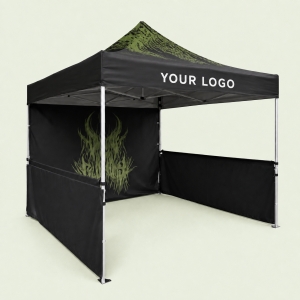
A canopy tent is a four-part system. The top is a coated polyester fabric, the frame is powder-coated steel or aluminum, the joints and feet are nylon or cast aluminum, and printed flags run on separate poles with independent bases. The canopy top carries the brand image, yet the frame decides how long that image survives.
In practice, the top fabric is almost always oxford polyester. Mills weave it from 210D to 600D yarn, then laminate a PVC or PU coating onto the reverse side. Denier measures yarn thickness: 9,000 meters of 600D yarn weigh 600 grams, so a higher number means a heavier, more tear-resistant thread. Fabric weight is quoted separately in grams per square meter, or gsm, because weave density and coating both add weight beyond the yarn count.
Which Advertising Tent Fabric Weight Suits My Application?
Overall, fabric weight is the fastest filter when comparing advertising tent options for commercial use. A 210D top at roughly 130 gsm suits indoor promotions and one-off events, while 600D at 240–280 gsm handles weekly setup, outdoor markets and rental fleets.
Rental companies usually standardize on 600D PVC, for instance, because one fabric grade simplifies repairs and stock control. Brand owners with lighter schedules can step down to 420D and notice little practical difference.
What Does the D Number Mean in Tent Fabric?
Denier describes the yarn rather than the finished cloth. Two 600D fabrics can differ by 40 gsm when one mill weaves at a tighter pick count or applies a heavier coating. A specification sheet should list denier, gsm and coating weight together for that reason. A physical swatch, however, beats a data sheet every time.
Higher denier improves tear strength and opacity. It raises packed weight and stiffness as well. On a 3 x 3 m advertising tent the gap between 420D and 600D is roughly 1.5 kg of fabric, which matters for one-person setups.
PVC or PU: Which Coating Suits an Advertising Tent?
PVC coating forms a thick plastisol film that resists abrasion, blocks water completely and tolerates ponding. It dominates rental fleets, food stalls and industrial canopies for that reason. PU coating is thinner and more pliable, so printed panels fold smaller and crease less. It also accepts photographic print detail at a finer resolution.
Conversely, cold-climate markets favor PU on handling and print quality. Rainy, high-traffic rental use favors PVC on durability per dollar.
What Actually Makes a Canopy Tent Waterproof?
In short, three details decide advertising tent performance: hydrostatic head, seam treatment and roof geometry.
Hydrostatic head, the standard waterproof rating, measures the water column a fabric holds before leaking. An 800 mm rating sheds light drizzle, 1,500–2,000 mm copes with steady rain, and 3,000 mm and above survives prolonged downpours. Water rarely enters through the coated panel. It enters through stitch holes and seams. Taped or welded seams, plus a valance that directs runoff away from the legs, matter more than a headline rating.
Roof pitch matters as well. A peaked roof sheds water quickly. A flat canopy can pond, stretch and eventually sag. Specify the coating rating first, then inspect the seams.
Which Fabric Suits a Printed Advertising Tent?
Three fabrics dominate the promotional market, and an advertising tent flag material guide has to rank them by application before price.
PE tarpaulin is woven high-density polyethylene with a laminated film, typically 80–200 gsm. It is the cheapest option and fully waterproof, although it tears at the eyelets, fades within one season and stiffens in cold weather. It suits dust covers, temporary site barriers and short-haul cargo protection better than a branded canopy.
Meanwhile, PVC tarpaulin is a knife-coated heavy cloth at 440–610 gsm, joined by high-frequency welding. It is extremely durable and remains the standard for truck curtains, inflatables and large wall banners. It is also heavy, bulky to ship and hard to print with fine gradients.
Polyester oxford, the standard advertising tent cloth, sits between the two. It prints well, packs small and balances cost against durability. That combination explains its dominance in the pop-up canopy category.
Which Frame Should Carry a Canopy Tent?
Therefore, frame choice follows wind exposure and setup frequency, not fabric choice alone.
First, steel frames use square tube from 25 mm to 40 mm with a wall thickness of 0.8 mm, 1.0 mm or 1.2 mm. Powder coating of 60–80 microns protects the surface, and galvanized tube adds corrosion resistance for coastal sites. A 1.0 mm wall is the practical minimum for commercial work, since thinner tube dents at the leg joints after repeated folding.
Aluminum frames in 6063-T5 alloy, usually a 30 mm to 50 mm hexagonal or square profile, weigh 30–40 percent less and never rust. They cost more. They remain the better choice for island resorts, seaside promenades and any program where one person must carry the canopy.
Finally, truss frames add diagonal aluminum bracing across each roof span. A 3 x 6 m footprint needs that bracing, because an unbraced frame of that span flexes under wind load.
Connectors, meanwhile, deserve equal scrutiny. Nylon joints are light and adequate for occasional use. Cast aluminum or reinforced nylon with steel pins survives daily rental cycles. Spring-loaded push pins save several minutes per setup compared with bolt-and-nut assembly.
Flag poles follow a separate logic. Fiberglass poles flex and recover, so they dominate feather flags. Aluminum poles hold a straighter shape and suit teardrop and rectangle banners. Carbon-hybrid poles cut weight for travelling sales teams.
How Is a Logo Printed on Advertising Tent Flag Fabric?
Print method determines color depth, minimum order and how an advertising tent logo ages outdoors, and no advertising tent flag material guide can skip it.
Dye sublimation is the default for polyester canopies and knitted flags. Heat at 180–220 °C turns the ink into gas that bonds inside the fiber, therefore the image cannot peel, crack or wash off. It supports unlimited colors, photographic gradients and full-bleed coverage across the roof and valance. It is also the only method that prints a readable mirror image on the reverse of a flag.
In contrast, screen printing lays thick plastisol or water-based ink on a ready-made panel. It is economical for one to three spot colors in volume and delivers a dense, opaque look on darker fabrics. Each color needs a screen and a setup charge, and heavy ink can crack along fold lines.
In addition, heat transfer vinyl suits small runs, names and numbers on team kits or staff aprons. It is fast and cheap at low volume. Large panels show visible seams between vinyl sheets.
Digital UV printing on PVC banner stock remains the workhorse for wall banners, backdrop panels and fence wraps used alongside an advertising tent. With lamination it holds color for two to three years outdoors at 1,440 dpi.
Embroidery belongs on apparel and caps rather than canopy tops, because stitch density cannot cover a 3 m roof economically.
A logo printing brief should supply vector artwork in AI, EPS or PDF with fonts outlined. Add Pantone references for brand colors and allow 25 mm bleed plus a safe margin from seams and pole sleeves. Ask for a strike-off or digital proof before production, since screen colors rarely match a fabric print exactly.
Which Fabric Works for Custom Feather Flags?
Advertising tent flags live under constant fluttering load. The fabric must be light, elastic and colorfast at the same time.
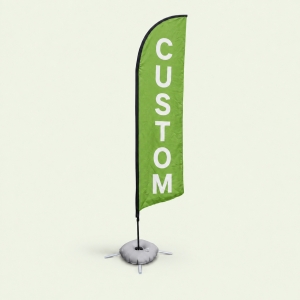
Warp-knitted polyester is the standard. At 110 gsm it is the economy grade for indoor displays and short campaigns. At 130 gsm it handles normal street use. At 160 gsm it resists fraying and holds shape in coastal wind. Knitted construction stretches slightly, which lets the flag absorb gusts instead of splitting along the hem.
Woven polyester at around 115 gsm serves rectangle banners and fence wraps. It holds a flat edge and prints crisp text, though it has less stretch than a knit. Reinforced corners and eyelets every 50–60 cm keep a woven banner stable.
Mesh polyester, with 30–40 percent open area, is the correct choice for very windy or coastal sites. Air passes through the perforations, so pole load drops sharply and the banner stops acting like a sail.
Blockout fabric, a three-layer white-core laminate, is required for double-sided flags that must read correctly from both sides without ghosting. Standard through-printed flags show a mirrored image on the reverse. That works at a distance and confuses buyers in a showroom.
Notably, finishing decides service life as much as the cloth. Look for double-stitched hems with four to six stitches per centimeter, webbing-reinforced pole sleeves, bar-tacked stress points and nickel eyelets. On feather flags, a bungee cord and a rotating snap swivel reduce twisting fatigue at the pole tip.
What Advertising Tent Size Fits My Booth?
Size selection in this advertising tent flag material guide follows footprint and headcount, not logo size.
Moreover, eave height matters as much as floor area, which the size chart sets out for every model. A 2.5 m eave is comfortable for standing visitors. A 3.0–3.2 m eave suits tall equipment or banner frames, and a peak adds roughly 0.9–1.2 m on top. Allow 0.5 m of clearance on each side for guy ropes and ballast, then check venue ceiling limits before choosing a peak height.
A 3 x 3 m canopy with a 2.5 m eave covers most retail, event and forecourt needs. Staff who stand behind a counter for eight hours need 3 x 4.5 m instead, because working depth matters more than display width.
Which Advertising Tent Flag Height Suits My Site?
Flag height matches viewing distance. Base choice matches the surface underneath.
A 2.8 m feather flag works indoors, in showrooms and on narrow pavements where the tip must stay below the first-floor line. A 3.4 m flag is the most common outdoor size, visible from roughly 30–40 m, and it clears pedestrians comfortably. A 4.5 m flag serves roadside frontage and car dealerships at 60–80 m viewing distance. A 5.5 m pole belongs on open lots and highway frontage, where the message must be read from a moving vehicle.
Teardrop flags at 3.4 m read well in tight retail frontage, because the wide top carries a logo at eye level. Rectangle banners at 3 x 1 m suit fence lines and event backdrops.
Above all, base selection is a safety decision, not an accessory choice. A cross base with a water bag is portable and needs filling on site. A steel square plate of 10–15 kg suits paved areas without space for a cross. A 40 cm ground spike is for grass and soil only. A three-leg ground stake suits soft ground on event fields. Wind ratings for feather flags typically stop around 30–40 km/h. Fold the flag down before a storm rather than trusting the base.
Which Accessories Make a Canopy Tent Practical?
A canopy without accessories is a roof on four legs. Sidewalls, ballast and lighting turn it into a working space, and the specification of each one deserves the same attention as the top.
First, sidewalls are usually 210D to 300D PU polyester, sold as half walls at 1.1 m or full walls at 2.0–2.2 m. A cathedral window with a zip lets staff take payment while the wall stays closed. Buy sidewalls together with the canopy, because dye lots drift between production runs and a later addition often reads as a slightly different white.
Ballast is a safety component. A 3 x 3 m canopy needs roughly 20 kg per leg on open ground, spread across steel plates, sandbags or water barrels filled on site. Traffic cones and rope do not count as ballast.
Lighting and anchoring follow the same logic. A 12 V LED strip under the eave keeps product colors readable after dusk without adding heat. Ground stakes of 30–40 cm hold on grass; paved sites need plates instead. A wheeled storage bag and a spare connector set save far more time over a season than they cost.
Valance height also carries a practical message. A 20–40 cm valance holds the logo at natural eye level for visitors approaching a 2.5 m eave, which is why most brands print there rather than on the roof slope.
How Do I Compare Canopy Tent Quotes Fairly?
Two quotations for the same 3 x 3 m advertising tent can differ by 40 percent and still be honest, because the specifications differ inside the price.
Check the fabric grade first: 210D, 300D or 600D, and the coating weight in gsm. Check the print method: dye sublimation across the full roof, or a printed valance only. Check the frame: wall thickness in millimeters and connector material. Check the finishing: hem stitch density, seam taping, eyelet count and zipper brand.
Then compare landed cost. Carton volume drives sea freight more than weight does, and a 600D set packs larger than a 420D set. Add duty, port charges and inland delivery before ranking suppliers.
How Does This Advertising Tent Flag Material Guide Help Me Choose?
Four questions resolve most specification decisions for an advertising tent flag program.
Where will the unit stand? Indoor retail favors light 300D PU fabric and a compact 2.5 m frame. An exposed forecourt demands 600D PVC, a braced frame and 20 kg of ballast per leg.
How often will it be handled? A single annual exhibition justifies a 210D or 300D top. Weekly markets and rental fleets justify 600D with aluminum connectors.
From how far must the message be read? Visitors at 50 m respond to one 4.5 m flag more than to three small canopies. Visitors who walk past at 3 m read a printed valance instead.
How will it travel? Fabric weight and pole count decide whether one person can load a van alone. A 3 x 6 m truss system rarely suits a solo operator.
Ultimately, total cost of ownership settles the argument. A 210D set replaced every season costs more over three years than one 600D set, and it produces three times the waste.
How Long Does Tent Fabric Last?
Advertising tent fabric life depends on UV hours rather than calendar age. A 130 gsm flag printed by dye sublimation holds strong color for roughly 300–500 hours of direct sun, which equals one to two seasons of daily street exposure. A 600D PVC canopy top on a shaded forecourt can serve three to four years.
In fact, heat, salt and folding stress age fabric faster than rain. Coastal sites should expect 30 percent shorter life unless aluminum frames and 160 gsm flags are specified. Repeated folding along the same crease breaks coating, so alternate the fold pattern between setups.
In addition, basic care extends life noticeably. Rinse the advertising tent flag with mild soap and water, never with chlorine or solvent. Dry the fabric completely before storage, because mildew stains polyester permanently. Store it in a breathable bag rather than sealed plastic wrap. Touch up frame scratches with enamel to stop rust. Replace a bent pole immediately, since one bent section abrades the pole sleeve on every gust.
What Should I Confirm Before Ordering an Advertising Tent Flag?
Ask for the fire retardancy report first. Markets, exhibition halls and hotels increasingly require NFPA 701, CPAI-84 or EN 13501-1 documentation, and a certificate cannot be added after the goods are sewn.
Furthermore, five commercial details deserve equal weight. Request a physical swatch of the exact fabric grade, not a competitor sample. Ask for a digital or strike-off proof against Pantone references. Confirm the minimum order quantity per print and per size. Check carton dimensions and gross weight, since freight class changes the landed cost. List spare parts in the quotation, including pole sections, connectors, feet and a storage bag.
A small paid sample of the final specification removes most of the risk. Test it outdoors for two weeks, fold it five times and inspect the seams. A sample that holds predicts a production run that holds, and that test closes this advertising tent flag material guide.

 Canopy Tent Flags