 Skip to content
Uncategorized
Outdoor Rainwear Protection Guide

Dec
Whether you are a hiking enthusiast who loves mountain challenges, a cycling lover who enjoys speed, or a camping player who pursues comfort, a professional outdoor raincoat is an indispensable core in your gear library. This guide will comprehensively analyze mainstream rainwear types on the market, from materials and applicable scenarios to advantages and disadvantages, helping you make wisest outdoor rainwear choice in wind and rain.
1: Understanding the Core – Materials and Performance of Outdoor Rainwear
Because Choosing outdoor rainwear first requires understanding two key performance indicators: Water Pressure Resistance (Waterproofness) and Moisture Permeability.
Water Pressure Resistance: Refers to fabric’s ability to withstand water pressure, measured in millimeters of water column (mmH₂O). A higher value indicates better resistance to heavy rain.
5,000 mmH₂O: Suitable for light rain or sudden showers.
10,000 mmH₂O: Adequate for heavy rain, a reliable choice for urban commuting and general outdoor activities.
20,000 mmH₂O or above: Withstand storms, typhoons, and other extreme weather, ideal for prolonged outdoor work or professional expeditions.
Moisture Permeability:Refers to fabric’s ability to release sweat vapor produced by body, typically measured in grams per square meter per 24 hours (g/m²/24h). A higher value indicates better breathability and reduces likelihood of feeling stuffy.
Material Type:Coated ,Laminate ,Composite/EVA
Common Process/Representative:PVC, PU, TPU coating,GORE-TEX, eVENT, other proprietary membranes,EVA (Ethylene-Vinyl Acetate)
Core Characteristics:A waterproof layer is applied to a base fabric (e.g., nylon, polyester). A waterproof and breathable microporous membrane (e.g., ePTFE) is bonded to an outer fabric and lining.Soft, lightweight synthetic material.
Advantages:Strong waterproof performance, cost-effective, durable.Excellent balance of waterproofness and breathability, preferred choice for high-performance outdoor activities.Extremely lightweight (160-220 grams), but easy fold store.
Disadvantages:Generally poor breathability; PVC material is relatively heavy and may degrade over time.Expensive; the outer layer requires protection against abrasion.
Generally inferior wind resistance and durability compared to the first two; limited long-term water pressure resistance.
2: Find the Right Match – Detailed Analysis of Different Rainwear Types and Applicable Scenarios
1. For Ultimate Protection: Two-Piece Rain Suit
Design: Separate jacket rain pants.
Material: Often uses durable coated or laminate fabrics.
Ideal Scenarios & Users:
Motorcycle/Long-distance cycling: Provides optimal full-body protection, preventing water ingress.
Professional hiking/mountaineering: Allows flexibility in severe weather; jacket and pants worn or removed separately.
Outdoor work: Comprehensive protection for prolonged outdoor stays.
Pros: Best overall protection, relatively flexible movement, components mixed and matched.
Cons: Slightly more cumbersome to put on/take off, bulkier to pack.
2. One-Piece / Coverall Rainwear
Design: Covers the body from head to toe in one piece.
Material: Ranges from lightweight EVA to professional coated fabrics.
Ideal Scenarios & Users:
Urban commuter cycling/E-bike riding: Quick to put on/take off, good coverage.
Medium to low-intensity outdoor activities like hiking, fishing, spectating events: For coping with sudden downpours.
Backpackers prioritizing extreme lightness and packability (specifically lightweight EVA models).
Pros: Quick to don/doff, excellent waterproof sealing, lightweight versions are exceptionally easy to pack.
Cons: Movement restricted, significant breathability challenges, hem may catch in bicycle wheels while riding.
3. Rain Jacket / Hardshell
Design: Typically a short or mid-length jacket with tailored fit.
Material: Primarily high-performance laminate fabrics (e.g., GORE-TEX).
Ideal Scenarios and Users:
High-intensity outdoor sports like mountain hiking, climbing, trail running that involve exposure to wind and brush.
Multi-day mountaineering, expeditions: For coping with rapidly changing mountain weather.
Outdoor enthusiasts seeking versatile gear that doubles for everyday wear.
Pros: Highly breathable, windproof, maximizes freedom of movement, often helmet-compatible.
Cons: Because most expensive, requires rain pants for full-body protection.
4. For Ventilation and Versatility: The Poncho
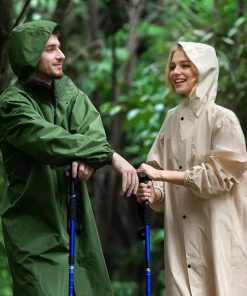
Design: Typically featuring a sleeveless, cape-like design, the poncho is one of the most simple and recognizable forms of rain protection.
Material: Options are varied, ranging from ultra-lightweight, packable fabrics to more durable, professionally oriented materials.
Ideal Scenarios and Users: This design is particularly well-suited for leisurely outdoor activities like camping or music festivals, as it can easily cover both the wearer and a backpack. Furthermore, it is excellent for temporary urban use or family outings, which is why it is a common choice in children’s versions.
Pros: Its primary advantages include high compatibility with gear, the ability to cover a backpack, and generally good ventilation. Additionally, ponchos often come in a wide variety of stylish designs.
Cons: However, this design comes with significant trade-offs. It offers poor wind resistance and can flap excessively in open areas or while cycling, resulting in weaker overall protection compared to more fitted garments.
Chapter 3: Answering Doubts – Frequently Asked Questions (FAQ)
Q1: I mainly ride and hike on weekends. So do I need to buy the most expensive GORE-TEX hardshell?
A: Not necessarily. If your activities are moderate intensity and not in extreme environments, a two-piece suit or high-quality one-piece rainwear with a water resistance rating above 10,000mm and breathable features might offer better value. GORE-TEX is better suited for prolonged, high-exertion, wet, and windy harsh environments.
Q2: What should I do if the rainwear feels stuffy and not breathable?
A: Pay attention to the product’s moisture permeability rating (above 5,000 g/m²/24h for a better experience) and physical ventilation features like pit zips or back vents. For coated rainwear, choosing a style with a mesh lining can also improve comfort.
Q3: Why does the inside still feel damp in the rain even though the rainwear has high parameters?
A: There are two likely reasons: First, condensation (body sweat vapor cannot escape), highlighting the importance of breathability. Second, water seeping in through seams or zippers. Ensure critical seams are tape-sealed and zippers have storm flaps or are waterproof zippers.
Q4: How do I maintain my outdoor raincoat to extend its service life?
A: After use, so wipe it down with a damp cloth and air dry in a shaded place, avoiding direct sunlight. Clean it regularly with a technical cleaner (avoid fabric softeners) to restore fabric’s water-repellency. Tumble drying on low heat after washing reactivate DWR (Durable Water Repellent) coating.
