 Skip to content

Outdoor Chair
Camping Chair Material Guide

Oct
A camping chair rarely fails at the logo. It fails at a weld, a rivet or a seam that met a load it was never specified for. Frame wall gauge, yarn denier and coating weight decide whether one chair survives three seasons of gravel, salt and weekend loading. This camping chair material guide compares the options by the loads they actually carry. The questions below follow the order a first-time buyer meets them.
What Materials Make Up an Outdoor Camping Chair?
Camping Chair Material Guide
A camping chair is a frame, a fabric skin, a coating and a set of joints. The frame carries the load. The fabric spreads that load across the seat and back. The coating decides how the fabric behaves in rain, sun and repeated folding.
In short, four frame materials and six fabric families cover almost every chair sold today. Steel and aluminum hold the volume market. Carbon fiber and hardwood sit at the top and design ends.
Moreover, the fabric is where most of the cost and most of the failure risk sit. A chair sold at a low price usually saves money on the cloth before it saves money on the tube.
Joints matter as much as either. Nylon, glass-filled nylon and steel rivets decide whether a chair still folds smoothly after two hundred cycles.
Which Frame Material Should Carry a Camping Chair?
Above all, frame choice follows transport and load, not price alone.
Typically, steel frames use welded tube with a powder coat of 60–80 microns. A 0.8 mm wall dents at the hinge after a season of adult use. A 1.0 mm wall is the practical minimum for anything sold as a load-bearing chair.
Meanwhile, aluminum frames use 6061-T6 or 6063-T5 tube with an anodized layer of 10–15 microns or a powder coat. They weigh 30–40 percent less than steel at the same load rating and never rust. They dent more easily under a sharp impact.
In contrast, ultralight frames use 7001 aluminum in a thinner wall. The chair drops below 1.3 kg and the load rating drops with it. That trade is acceptable for a backpack, not for a rental fleet.
Indeed, weld quality separates good frames from cheap ones. A TIG weld with full penetration holds. A spot weld that only joins the surface cracks at the hinge within a season.
What Does the D Number Mean in Camping Chair Fabric?
Camping Chair Material Guide
Specifically, denier describes the yarn, not the finished cloth. Nine thousand meters of 600D yarn weigh 600 grams, a definition covered under textile measurement units. A higher number means a heavier, stronger thread.
Instead, fabric weight is quoted separately in grams per square meter. Coating weight and weave density both add grams that the denier figure never shows.
Two 600D fabrics can differ by 60 gsm. One mill weaves at a tighter pick count or applies a heavier coating. That difference decides whether the seat sags after a summer.
A specification sheet should list denier, gsm, coating type and coating weight together. A single denier number tells a buyer almost nothing.
Which Camping Chair Fabric Weight Suits My Use?
A camping chair material guide that starts with price usually ends with a sagging seat, because fabric weight predicts load behaviour long before a logo does.
First, polypropylene woven cloth is the cheapest option on the market. It tears at the seam, fades within a season and stiffens in cold weather. It suits a giveaway chair that carries a logo for one summer.
Oxford polyester at 600D is the workhorse of the category. It balances abrasion resistance, print quality and cost. Most branded camping chairs sold above entry level use it.
Then, ripstop nylon serves the ultralight end. The grid stops a tear from running and keeps the packed weight under 1 kg. It costs two to three times more per meter than oxford.
Likewise, coated mesh serves hot climates. Air passes through the weave, so the sitter stays cooler and the fabric dries in minutes.
PU, PVC or Silicone: Which Coating Suits Outdoor Use?
Notably, PU coating dominates camping chairs for good reason. It flexes with the seat, accepts fine print and adds little weight. It also degrades under UV unless the formula includes a stabilizer.
Conversely, PVC coating wins on abrasion and cost. It suits contract furniture and poolside chairs where the fabric rarely folds. It cracks in cold storage and cannot be recycled easily.
Finally, silicone coating serves the ultralight segment. It adds almost no weight and stays flexible at low temperature. It costs the most and resists printing.
Ask for the coating weight in gsm, not just the coating name. A 600D fabric with 30 gsm of PU behaves very differently from the same cloth with 80 gsm.
What Makes Camping Chair Fabric Breathable and Cool?
In fact, breathability comes from the weave and the construction, not from a marketing label.
First, open-weave mesh lets air pass through the seat and back. A PVC-coated mesh chair stays cool in direct sun because sweat evaporates instead of pooling.
Secondly, three-dimensional spacer mesh uses two knit faces joined by monofilament yarn. The 3–8 mm gap moves air along the back and stops the fabric from clinging.
Thirdly, perforated oxford punches small holes through a coated cloth. It breathes less than mesh and keeps more of its strength. It suits a chair that must print a large logo and still vent some heat.
A solid coated oxford seat traps heat. That is acceptable for a cold-weather chair and uncomfortable for a beach chair sold in July.
Seat sag also affects comfort. A 420D seat stretches under 90 kg within a season. A 600D seat with a reinforced seam holds its shape far longer.
Is Nylon or Polyester Better for Camping Chair Fabric?
Generally, nylon is stronger per gram. It resists abrasion better and feels softer against skin. It also stretches more and degrades faster under UV unless it is solution dyed. A camping chair material guide that stops at strength misses the two failures that matter outdoors: UV fade and stretch.
Meanwhile, polyester is more UV stable and cheaper. It holds color longer in strong sun and resists stretching. It loses to nylon on tear strength at the same weight.
In addition, ripstop nylon with a grid of thicker yarn solves the tear problem. The grid stops a rip at the next square and keeps the chair usable after damage.
Moreover, Cordura nylon at 500D suits the hard end of the market. It takes abrasion from rock, concrete and vehicle floors without thinning.
A blended cloth rarely helps here. Mills either weave nylon or polyester, and mixing the two in one yarn complicates dyeing without adding much.
Ultimately, test the cloth, not the label. Fold a swatch eight times along the same line and inspect the coating. A coating that whitens at the crease will fail at the seat edge.
Which Fabric Suits Logo Printing on a Camping Chair?
Clearly, print method decides color depth, minimum order and how the logo ages.
First, screen printing lays plastisol or water-based ink through a mesh stencil. It suits one to three spot colors and holds up well on 600D oxford. Each color needs a screen and a setup charge.
Then, heat transfer prints a design on a carrier film and presses it into the cloth at 150–170 °C. It handles small runs and photographic gradients. It sits on the surface and can lift at the edges after repeated folding.
Additionally, Dye sublimation works on polyester mesh and light oxford. Heat at 180–220 °C turns the ink into gas that bonds inside the fiber. The print cannot peel because it is no longer on the surface.
Finally, embroidery suits headrest panels, armrest patches and carry bags. Stitch density cannot cover a full seat economically, and heavy stitching weakens a coated cloth.
Woven labels and PVC patches serve small logo areas. A woven label sewn into the seam costs little and looks considered. A debossed PVC patch on the back panel survives years of abrasion.
Laser engraving marks anodized aluminum frames without ink. It suits a brand that wants the mark on the structure rather than the cloth.
A custom logo printing brief should supply vector artwork in AI, EPS or PDF with fonts outlined. Add Pantone references and allow 10 mm bleed plus a margin from seams. Ask for a strike-off before production, because screen color rarely matches a coated fabric exactly.
Camping Chair Material Guide: Which Shape Fits My Trip?
Overall, shape follows the ground and the walk, not the brand.
First, a quad folding chair with four legs and an X-frame covers car camping, festivals and garden use. It folds flat in about five seconds and packs into a slim bag.
Then, a moon chair uses a curved cross frame and a bowl-shaped seat. It cradles the sitter and packs into a round bag. It suits lounging and reads poorly at a table.
A director chair pairs an aluminum frame with a flat seat and a side table. It suits craft fairs, catering and any setting where the sitter works with their hands.
A rocking chair adds curved runners to a folding frame. It needs level ground and suits terraces more than campsites.
A zero-gravity recliner locks at several recline angles. It belongs at home, at the pool or on a campsite where the vehicle carries it.
Also, an ultralight chair assembles from a shock-corded frame and a sleeve seat. It weighs under 1 kg and takes about ninety seconds to build.
Finally, a canopy chair adds a sunshade to a folding frame. It suits fishing, beach days and any site without tree cover.
What Camping Chair Size Fits an Adult?
Seat height matters more than total size, and the size guide lists every model by seat height. A 40 cm seat lets an adult sit at a standard camping table. A 28 cm beach seat forces the knees up and suits reclining only.
Meanwhile, seat width decides comfort for larger users. A 60 cm seat with a reinforced seam carries a 150 kg load without pinching at the hips.
Then check the folded length against the boot before ordering a container. A chair that folds to 100 cm does not fit a small hatchback without a diagonal load.
How Much Load Can a Camping Chair Hold?
Typically, load ratings on camping chairs run from 100 kg to 200 kg. The number should come from a static test at 1.5 times the rated load, held for at least one minute.
Generally, three points decide real capacity. The wall thickness at the hinge, the seam strength where the seat meets the frame, and the width of the fabric sleeve over the tube.
A 120 kg rating with a 1.0 mm steel wall is honest. The same rating with a 0.8 mm wall is optimistic and fails at the hinge.
European buyers increasingly ask for EN 581-1 and EN 581-2 documentation. Those standards cover safety requirements and mechanical test methods for outdoor furniture. A chair sold into the EU without them invites a return and a claim.
Therefore, label the rating on the chair and in the listing. An unlabelled chair shifts liability to the seller when a user exceeds a limit nobody published.
Which Accessories Make a Camping Chair Practical?
A bare chair is a seat. Accessories turn it into a station, and any camping chair material guide has to treat them as structure rather than trim.
A cup holder moulded into the armrest costs little and sells a chair on its own. A mesh side pocket holds a phone, a torch and a bag of coffee.
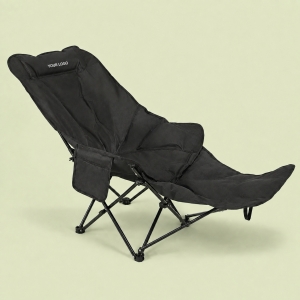
A padded headrest adds comfort on a high-back model and gives the printer a clean panel for a logo.
A carry bag with a shoulder strap and a drawcord closure decides how the chair travels. A bag with a webbing handle and a reinforced base survives baggage handling.
Foot pads spread load on soft ground. Wide plastic caps stop a leg from sinking into sand or wet grass. Steel spikes suit hard ground and damage a tent floor.
A canopy shades the sitter and adds wind load. Specify a canopy that clips to the frame rather than a fabric hood that relies on tension alone.
A cooler bag hung under the seat adds convenience and changes the balance of the chair. Check the loaded centre of gravity before approving the design.
Small parts decide repeat orders. A spare hinge pin and a spare foot cap cost cents and prevent a full replacement.
How Do I Compare Camping Chair Quotes Fairly?
In fact, two quotations for the same folding chair can differ by 40 percent and both be honest, because the specifications differ inside the price.
Check the fabric first: denier, gsm and coating weight. A 600D chair with 30 gsm of PU is not the same product as a 600D chair with 80 gsm.
Check the frame: tube diameter, wall thickness and coating. Ask for the micron figure on the powder coat and the anodized layer.
Check the joints: nylon, glass-filled nylon or steel, and the rivet diameter.
Check the stitching: four to six stitches per centimeter, bar-tacks at the stress points, bound seams on the seat edge.
Then compare landed cost. Carton volume drives sea freight more than weight does, and a 600D chair packs larger than a 420D chair.
How Do I Choose the Right Camping Chair for Me?
In short, four questions settle most orders.
Where will the chair sit? A gravel pitch and a wooden deck punish the fabric differently. A beach demands mesh and wide feet.
Who will carry it? A chair under 1.5 kg suits a walk of two kilometers. A 5 kg chair suits a vehicle.
How long must it last? A one-event giveaway justifies PP woven cloth. A rental fleet needs 600D with a 1.0 mm steel wall.
What must the logo do? A small woven label suits a premium brand. A full-panel sublimated print suits a promotional program.
Total cost of ownership settles the rest. A cheap chair replaced every season costs more across three years than one 600D chair, and it produces three times the waste.
How Long Does a Camping Chair Last?
Fabric life depends on UV hours, not calendar age. A 600D PU oxford seat holds color for roughly 400–700 hours of direct sun, which equals two to four seasons of weekend use.
Meanwhile, coating life depends on folding. Every fold along the same line stresses the film. A chair folded identically a thousand times cracks along that crease.
Frame life depends on the hinge. A steel rivet in a nylon joint wears oval and the chair starts to lean. A steel pin in a glass-filled joint holds far longer.
Coastal use shortens everything by about 30 percent. Salt attacks the coating edges and accelerates corrosion at every scratch.
Of course, care is simple and rarely followed. Rinse with fresh water after a beach trip, dry fully before storage and keep the chair out of a hot car boot. Mildew stains polyester permanently.
Touch up frame chips with enamel to stop rust. Replace a bent leg immediately, because one bent tube abrades the fabric sleeve on every setup.
What Should I Confirm Before Ordering a Camping Chair?
Camping Chair Material Guide
Ask for the test reports first. EN 581-1, EN 581-2 and EN 1022 cover safety, mechanical strength and stability for outdoor seating. REACH and California Proposition 65 documentation covers restricted substances in the coating and the dye.
Five commercial details matter next. Request a fabric swatch of the exact denier and coating weight. Ask for a logo proof on the actual cloth. Confirm the minimum order per print method and per color. Check carton dimensions and gross weight, since freight class changes the landed cost. List spare parts in the quotation, including hinge pins, foot caps and a carry bag.
A paid sample removes most of the remaining risk. Sit on it, fold it twenty times and leave it in the sun for two weeks. A chair that survives that test predicts a production run that holds, and that sample closes this camping chair material guide.

 Canopy Tent Flags